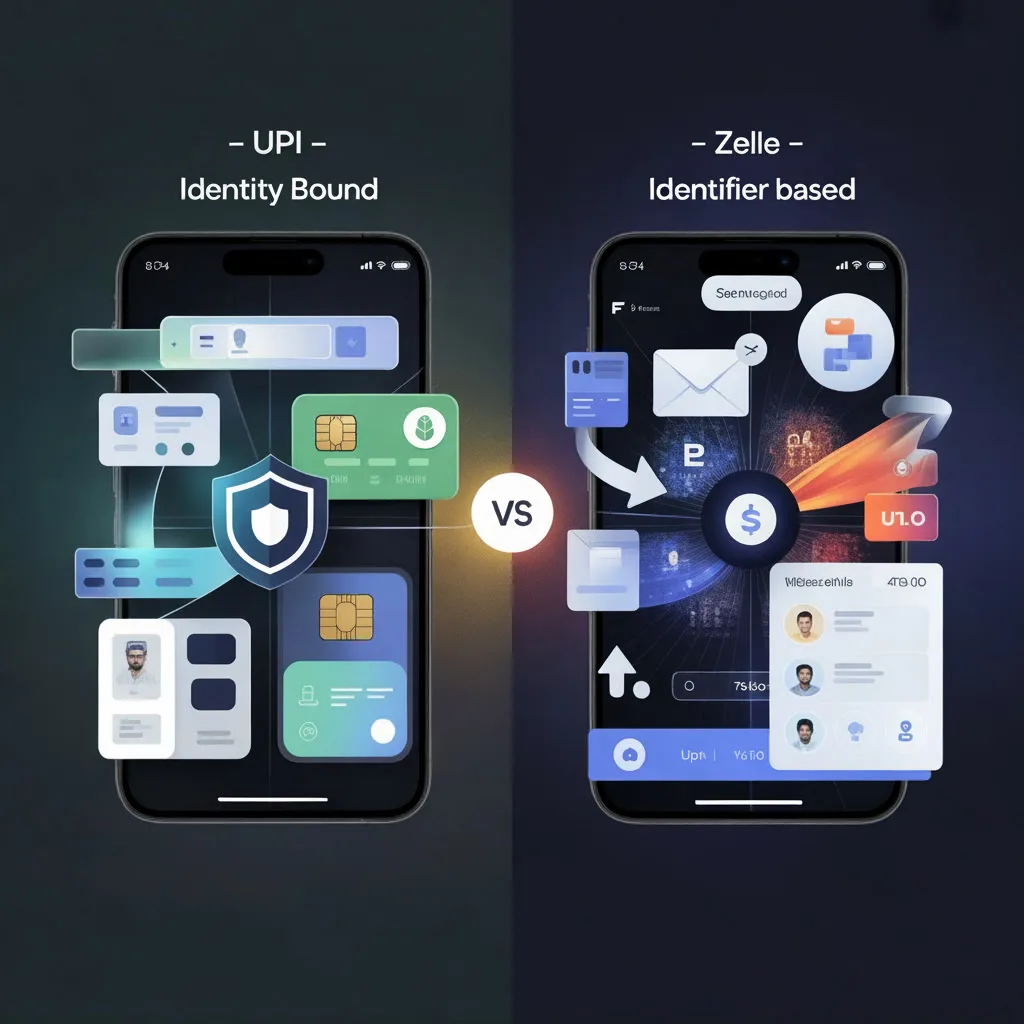
Two payment systems. Two philosophies. One critical trade-off between security and convenience.
A recent post on UPI fraud trends got me thinking about the two dominant peer-to-peer (P2P) payment systems across the globe: UPI (India) and Zelle (USA).
At a glance, both enable instant bank transfers. But under the hood, they follow completely different security architectures, onboarding models, and fraud prevention strategies.
To put it simply: comparing UPI and Zelle is like comparing chalk and cheese.
Why payment system security matters
Instant payment systems have made sending money faster and easier, but speed also creates new risks. Unlike traditional card payments, most peer-to-peer payment systems move money almost instantly and are difficult to reverse once authorised. This makes them attractive targets for scammers using phishing, impersonation, fake payment requests, and social engineering tactics.
The security model of a payment system plays a major role in how difficult it is for fraudsters to exploit users. Understanding these differences can help users make safer decisions when sending money online.
What is UPI and Zelle?
UPI (Unified Payments Interface) is a real-time payment system operated by the National Payments Corporation of India and launched in 2016 with backing from major Indian banks.
Zelle, on the other hand, is owned by Early Warning Services, a fintech consortium backed by leading US banks.
To keep the comparison fair, we’re focusing only on bank-backed P2P rails, excluding standalone apps like Venmo or Cash App.
UPI Security Model: Built on Strong Identity Binding
UPI is designed with a security-first approach, where user identity is tightly bound to device, SIM, and bank credentials.
1. SIM Binding (Core Anchor)
When you onboard to UPI:
- The app verifies that your SIM matches your bank-registered mobile number
- No match = no access
👉 This ensures strong identity linkage from day one
2. SMS-Based Verification
The app sends a silent SMS to verify:
- SIM is active
- Device controls the number
This establishes possession-based authentication—a key pillar in fraud prevention.
3. Auto-Read OTP with SMS Hash
UPI apps automatically read OTPs using secure SMS hashing.
This is not just convenience—it actively reduces:
- OTP phishing attacks
- Social engineering scams
👉 Users don’t manually share OTPs, cutting off a major fraud vector.
4. Device Binding (Not Just Fingerprinting)
UPI doesn’t rely on “this looks like you.”
Instead, it enforces:
- Strict device binding
- Only the registered device can transact
👉 This dramatically limits account takeover risks.
5. App Integrity & Signature Checks
UPI apps verify their own integrity to detect tampering or malicious modifications.
👉 If the app is compromised, the system breaks early—before fraud can scale.
UPI Fraud Risks: What Still Exists?
No system is bulletproof. UPI still faces some risks:
- SIM Swap Attacks – Fraudsters port numbers to new devices
- Social Engineering Scams – Users tricked into approving “collect requests”
- Mobile Malware – Malicious tools manipulating trusted devices
However, these require multi-step exploitation, making large-scale fraud harder.
How scammers exploit UPI and Zelle differently
Both UPI and Zelle are targeted by scammers, but the fraud patterns often differ because of how each system is designed.
SPONSORED
Common UPI scam methods:
- Fake collect requests
- QR code scams
- Fake customer support scams
- KYC update phishing links
- Screen-sharing fraud
Common Zelle scam methods:
- Bank impersonation scams
- Token flip scams
- Marketplace payment scams
- Refund scams
- Account takeover through phishing
In both systems, the biggest weakness is often not the technology itself, but social engineering that tricks users into authorising payments.
Zelle Security Model: Flexible but Fragmented
Zelle takes a very different approach.
Unlike UPI, it does not enforce standardized onboarding controls.
Key Characteristics:
- No mandatory SIM binding
- No strict device binding
- No requirement for matching phone number
- Banks define their own onboarding rules
👉 In short:
- UPI = standardized security controls
- Zelle = federated security model
Zelle Fraud Example: The “Token Flip” Scam
One of the most notable fraud patterns in Zelle is the token flip scam:
- Victim is told to send money to their “own email”
- Fraudster later registers that email with their bank account
- Funds are received by the attacker
👉 No hacking required—just timing and social engineering
This highlights a key gap:
Zelle relies more on identifiers than verified identity binding
UPI vs Zelle: Security Comparison
| Feature | UPI | Zelle |
|---|---|---|
| Identity Binding | Strong (SIM + Device) | Weak / Optional |
| Standardization | High (NPCI controlled) | Low (Bank dependent) |
| OTP Protection | Auto-read, secure | Varies |
| Fraud Surface | Narrow, layered | Wider, flexible |
| User Friction | Higher | Lower |
Which payment system is safer for everyday users?
The answer depends on the threat model.
UPI generally has stronger identity and device binding, which reduces some types of account takeover risks. However, it still relies heavily on user awareness, especially against collect request scams and phishing.
Zelle benefits from bank-level authentication and fraud monitoring, but its flexibility and reliance on email or phone-based tokens can create gaps that scammers may exploit.
For both systems, user behaviour remains the strongest security factor. Always verify who you are sending money to, avoid rushed decisions, and never approve payment requests without understanding them.
Security vs User Experience: The Trade-Off
UPI may feel like a strict bouncer checking IDs before letting you in.
Zelle feels more like a host waving guests through the door.
And that’s the real trade-off:
- UPI: More friction upfront, stronger fraud prevention
- Zelle: Smoother onboarding, higher fraud exposure
Final Thoughts: One System, Two Philosophies
If UPI operated with Zelle-style controls at India’s scale, fraud levels could be significantly higher.
At the same time, Zelle’s flexibility reflects a different market philosophy—prioritizing user experience over rigid controls.
So, is one better than the other?
Not necessarily.
They simply represent two fundamentally different approaches to digital payments security.